Reims
The Hunchback of Notre DameReims is the city in which Paquette la Chantefleurie’s daughter vanished and the story of their separation began. Recalled by Mahiette and later invoked by Paquette herself, it is more than a place-name: it holds the family’s origins, the evidence of a child’s disappearance, and the home to which mother and daughter hope to return. The narrative’s account moves between remembered streets and a hoped-for future, while leaving uncertainty around the precise circumstances of Paquette’s departure from the city.
Family origins and early life
Paquette was born into a modest household in Reims. Her father, Guybertant, earned his living as a minstrel on the barges and had once performed before King Charles VII during the royal coronation journey along the Vesle, from Sillery to Muison. He died while Paquette was still a child. Her mother, whose brother was a master brazier and coppersmith in Paris, then raised her alone. The family’s circumstances were precarious: mother and daughter lived on embroidery and toy-making, work that brought in only six farthings a week, and their income had fallen further after Guybertant’s death.
Mahiette’s recollection places the household on Rue Folle-Peine, along the riverfront. This specific address anchors the later catastrophe in an ordinary domestic setting: Paquette and her baby Agnes shared a room and a bed, and the loss took place while the mother briefly left the sleeping child at home. Reims is thus rendered not only as the city in which Paquette grew up, but as the intimate space of her household and the point from which her life was divided into before and after.
The disappearance of Agnes
Paquette’s infant daughter was named Agnes. According to Mahiette’s account, Paquette had taken her to a group of travelers who had arrived in Reims and were telling fortunes. The women admired and kissed the child, especially praising her feet and shoes. Mahiette also recounts the rumors circulating around the travelers, including accusations of child-stealing. Those charges belong to the fearful talk of the townspeople; they should not be treated as independent proof of what occurred. The story does, however, report that a neighbor later saw two travelers go into Paquette’s room carrying a bundle and leave after closing the door, and that cries were heard there afterward.
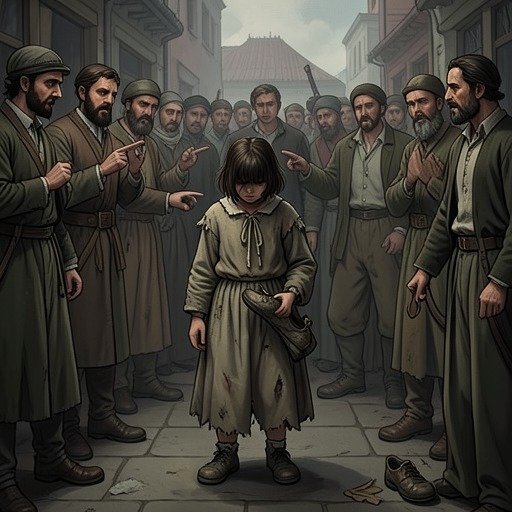
When Paquette returned, Agnes was gone. A little shoe was the only object left to her. In the same room she found a different infant, described in the account as visibly unlike her daughter. The substitution, the missing child, and the surviving shoe become the central facts of Reims’s place in Paquette’s story. The shoe is especially important because it is tangible evidence of the child’s former presence: years later, Paquette still keeps it and uses it to explain why she recognizes the young woman as her daughter.
The search that followed began in Reims. Paquette ran through the streets asking after her child, but no one could tell her where Agnes had gone. Mahiette recounts this search as a story of maternal grief, and notes that townspeople were moved by it. The city’s streets therefore carry two sharply contrasting meanings: they are the familiar surroundings of Paquette’s home, and the routes along which she searches without finding the child.
Departure and uncertain fate
After Agnes disappeared, Paquette herself vanished from Reims. Mahiette preserves several incompatible reports rather than resolving what happened. Some people said Paquette had left by the Fléchembault gate at nightfall; others placed her at the old Basée gate at daybreak. A poor man found her gold cross hanging on a stone cross at the fairground. Because the ornament had been a gift from the Vicomte de Cormontreuil and Paquette had kept it despite her poverty, its abandonment was taken by the townspeople as a sign that she had died.
Other witnesses reportedly said they had seen her walking barefoot on the road to Paris, which would suggest a different route out of Reims. Mahiette herself gives a more definite-sounding but still mournful interpretation: Paquette may have left by the Porte de Vesle, but departed from the world. The conflicting accounts leave her immediate fate uncertain within the story. What remains clear is that Reims loses her as well as her child, and that the city preserves fragments of her departure—a discarded cross, competing sightings, and the memory of a search that did not bring Agnes back.
Reims as the imagined homecoming
Fifteen years later, after mother and daughter recognize one another, Reims becomes the center of Paquette’s plans for a shared future. She tells her daughter that she has inherited property there: a field and a house, associated with her uncle Mahiet Pradon. She imagines taking the young woman away from their present danger and returning to the country where Paquette was born. Her hopes are domestic and concrete: a home, a field, and a bed in which her daughter can sleep beside her.
Paquette’s account to the officers likewise identifies her through Reims. She recalls Rue Folle-Peine, the child’s disappearance, and the little shoe she has preserved for fifteen years, and she insists that she is not a beggar but has an inherited field there. Reims supplies both her claim to family history and her proposed means of escape. Yet the promised homecoming remains a hope rather than an accomplished return. In the narrative, the city joins the beginning of the separation to the possibility of reunion: Paquette’s remembered address and treasured shoe help establish the bond, while her inheritance gives that bond an imagined place to live.